

Franchising is projected to exceed $920 billion in economic output in 2026, with nearly 845,000 units and 8.9 million jobs nationwide. Despite headlines about economic slowdown and credit tightening, the franchise sector is expanding — and smart operators are using SBA 7(a) and SBA 504 loans as strategic growth tools.
If you’re a current or aspiring franchisee, understanding how these SBA programs work could be the difference between owning one unit… and building a multi-unit platform.
The Franchise Sector Is Growing—Even in a Tight Economy
Key 2026 Franchise Outlook Data:
Projected output: $920+ billion
Estimated establishments: ~845,000 units
Employment: 8.9 million jobs
19% of franchisees control nearly 60% of total units
Franchising isn’t collapsing—it’s recalibrating. Growth is shifting toward disciplined operators in essential service sectors like:
Child services
Commercial and residential services
Health and wellness
Value-based retail
Why does this matter?
Because banks prefer structured, proven systems in uncertain markets. Franchise brands offer historical performance data, national marketing support, vendor purchasing power, and operational systems—making them inherently more “lendable” than independent startups.
And that’s where SBA financing becomes powerful.
What Is the SBA 7(a) Loan for Franchises?
The U.S. Small Business Administration 7(a) loan program is the most common SBA loan used by franchisees.
SBA 7(a) Highlights
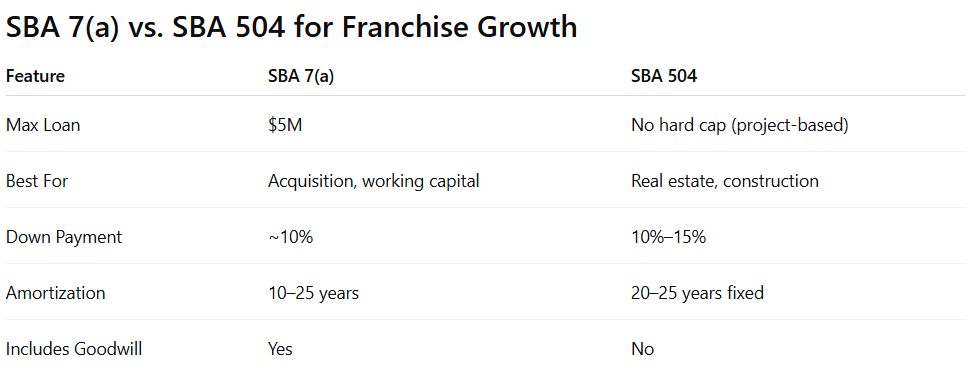
Up to $5 million in total financing
10-year term for business acquisitions
25-year term if real estate is included
As little as 10% equity injection
Can finance goodwill, equipment, working capital, and franchise fees
The 7(a) program is ideal for:
Buying an existing franchise location
Launching a new franchise unit
Acquiring multiple units
Partner buyouts
Refinancing higher-cost debt
Because lenders understand franchise models, especially brands listed in the SBA Franchise Directory, approvals can be faster and more structured than traditional conventional loans.
What Is the SBA 504 Loan for Franchise Real Estate?
The U.S. Small Business Administration 504 loan program is designed specifically for owner-occupied commercial real estate and heavy equipment.
SBA 504 Highlights
10% down payment (sometimes 15% for startups or special-use properties)
20–25 year fixed-rate financing on the SBA portion
Can finance land, construction, or building purchases
Structured as 50% bank / 40% SBA / 10% borrower
The 504 program works extremely well for:
Franchise restaurants buying their building
Hotel franchise construction
Childcare center facilities
Medical or wellness franchise properties
If you’re building a long-term, multi-unit franchise strategy, owning your real estate through a 504 loan can dramatically increase enterprise value.
Why the SBA 7(a) and 504 Programs Are a Franchisee’s Best Friend
Let’s break this down strategically.
1. Lower Capital Requirements
Instead of 25–35% down required by many conventional lenders, SBA programs often require:
10% equity injection
Flexible collateral structure
Longer amortizations
That preserves liquidity—critical in tight credit cycles.
2. Longer Terms = Stronger Cash Flow
10-year amortization on goodwill (7a)
25-year amortization when real estate is included
Fixed-rate 20–25 years on 504 SBA portion
Lower monthly payments increase:
DSCR strength
Expansion capacity
Multi-unit scalability
3. Banks Favor Franchise Systems
In tight lending environments, predictability wins.
Franchises provide:
Historical performance data
Standardized operating systems
Brand-level marketing
Vendor purchasing power
This predictability reduces perceived lender risk.
4. Fuel for Multi-Unit Expansion
Remember this data point:
Approximately 19% of franchisees control nearly 60% of total units
That means ownership is professionalizing.
The operators winning in 2026 are:
Installing GMs early
Building SOP-driven infrastructure
Leveraging centralized accounting
Scaling geographically in high-growth states like Texas, Florida, Arizona, and North Carolina
SBA financing allows disciplined expansion—not reckless growth.
SBA Construction Loans: The Complete 2026 Guide to Ground-Up & Owner-Occupied Projects

Most people misunderstand SBA construction loans—including a lot of bankers.
How to Qualify for an SBA Franchise Loan
While exact criteria vary by lender, most SBA franchise borrowers need:
Credit score: 680+ preferred
10% liquidity injection
Global cash flow support (if multi-entity)
Relevant management or industry experience
Post-closing liquidity reserves
In 2026, lenders are requiring deeper documentation and stronger liquidity positions.
Borrowers who maintain W2 income while launching semi-absentee franchises are often viewed more favorably.
SBA 7(a) vs. SBA 504 for Franchise Growth
Smart Strategy:
Many growing franchisees use both programs:
7(a) to acquire or expand operations
504 to purchase the property
This combination improves long-term asset control and EBITDA stability.
Larger Franchise Transactions & SBA Pari Passu Financing
For transactions exceeding SBA limits, lenders sometimes structure pari passu financing, where:
The SBA portion remains within program limits
A conventional loan is layered alongside
Risk is shared proportionally
This structure is common in:
Multi-unit franchise roll-ups
Portfolio acquisitions
Larger hospitality transactions
It allows franchisees to scale beyond $5 million in total capitalization while still leveraging SBA support.
Real Example: Disciplined Growth with SBA Financing
A multi-unit commercial cleaning franchise operator:
Purchased first unit using SBA 7(a)
Installed GM and documented SOPs
Stabilized margins over 24 months
Acquired second unit within same territory
Centralized accounting and recruiting
By year four, they controlled five units — with layered management .
That’s not hustle. That’s structured leverage. And SBA financing made it possible.
Why Franchising Is Structurally Attractive Right Now
Franchises are outperforming because of:
National purchasing power
Centralized marketing support
Unified technology stacks and AI integration
Access to structured lending programs
Add in demographic migration trends toward the Southeast and Southwest , and you have a clear expansion map.
Need-based sectors continue outperforming discretionary businesses.
The opportunity isn’t speculative. It’s system-driven.
Final Thoughts: Structure Wins in 2026
Franchising crossing $920 billion in projected output is not hype—it’s a structural signal.
The operators who win will:
Choose essential service brands
Maintain liquidity discipline
Use SBA 7(a) for operational growth
Use SBA 504 for real estate control
Install management layers early
Expand strategically — not emotionally
If you’re serious about franchise growth, the SBA isn’t just a lender.
It’s your capital partner.
And in a market that rewards discipline over speculation, the 7(a) and 504 programs may be your best friend.