

Most people misunderstand SBA construction loans—including a lot of bankers.
Some assume they’re slow, rigid, or only work for massive projects. Others think they’re just a cheaper version of a conventional construction loan. Both views are wrong, and that misunderstanding is exactly why so many SBA construction deals die before they ever break ground.
The truth is this: SBA construction loans are one of the most powerful tools available to business owners who want to build, expand, or own their commercial real estate—but only if they’re structured correctly. In this piece, I’ll break down how SBA construction loans actually work, what qualifies (and what doesn’t), and what lenders really care about in 2026—without the bank-speak or generic advice you’ll find everywhere else.
If you’re considering ground-up construction, a major build-out, or replacing rent with ownership, this will save you time, money, and a lot of frustration.
Build, expand, or own your commercial real estate — often with as little as 10% down, if the deal is structured correctly.
SBA construction loans are one of the most powerful — and most misunderstood — financing tools available to business owners. When structured properly, they allow you to build or renovate owner-occupied commercial real estate with long amortizations, competitive rates, and significantly lower equity requirements than conventional construction loans.
When structured poorly, they die in underwriting.
This guide explains how SBA construction loans actually work in 2026, what lenders really look for, and how to structure your project so it gets approved.
What Is an SBA Construction Loan?
An SBA construction loan is a loan backed by the SBA that allows a business owner to build, expand, or substantially renovate owner-occupied commercial real estate while reducing lender risk through an SBA guarantee.
Unlike conventional construction loans—which are short-term, high-equity, and often interest-only—SBA construction loans can combine:
Construction financing
Permanent financing
Long-term amortization (up to 25 years)
into a single construction-to-permanent loan structure.
Critical distinction:
SBA construction loans are designed for operating businesses, not real estate speculation.
What Types of Projects Qualify for SBA Construction Loans?
Eligible SBA Construction Projects
Ground-up commercial construction
Major renovations or expansions
Build-to-suit facilities
Tenant improvements tied to long-term occupancy
Construction combined with a business acquisition
Projects where land is already owned
Ineligible Projects
Speculative real estate development
Residential investment property
Flips or resale-driven construction
Projects without an operating business
Rule:
If the real estate primarily supports your business operations, SBA financing may be a fit.
SBA 7(a) vs SBA 504 Construction Loans
SBA 7(a) Construction Loans
Up to ~$5 million
Fixed or variable rates
Can include soft costs, equipment, and working capital
More flexible underwriting
Best for: Startups, mixed-use projects, and construction tied to acquisitions.
SBA 504 Construction Loans
Typically larger projects
Long-term fixed rates on the CDC portion
Lower rates for real-estate-heavy deals
Two-loan structure (bank + CDC)
Best for: Established businesses building or expanding owner-occupied facilities.
In some cases, hybrid 7(a) + 504 structures are used for optimal leverage and flexibility.
SBA Construction Loan Requirements (What Banks Actually Underwrite)
Owner-Occupancy Rules
Existing buildings: 51% owner-occupied
New construction: 60% at completion, increasing to 80% over time
Credit & Financial Strength
Strong personal credit (typically 680+)
Clean financial history
Adequate post-closing liquidity
Cash Flow
Ability to support debt after construction
Conservative, realistic projections
Experience & Management
Industry or operational experience matters
Strong operators outperform idea-only borrowers
Guarantees
Personal guarantees required
Additional guarantors may be necessary
SBA Construction Loan Down Payment Explained
One of the biggest advantages of SBA construction loans is leverage.
Typical Equity Injection
10%–20% of total project cost
When 10% Is Possible
Strong borrower profile
Solid contractor and budget
Stable industry
Reasonable project scope
Using Land as Equity
If you already own the land:
Its appraised value can count toward your down payment
This can significantly reduce required cash
What Increases Equity Requirements
Startups
Specialized or single-purpose properties
Limited liquidity
Aggressive projections
Example:
$3.5M total project
• $350K–$700K equity (cash, land, or combination)
• SBA-backed financing for the remainder
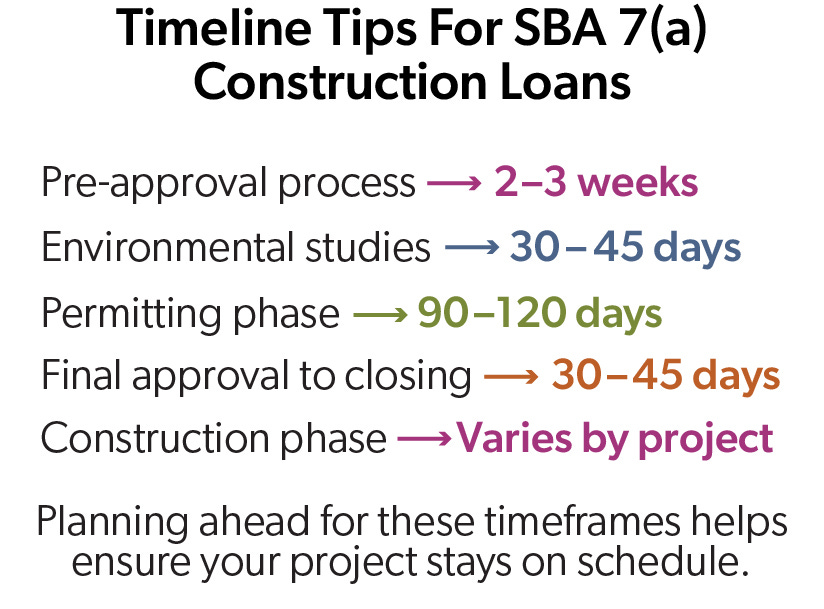
How Long Do SBA Construction Loans Take?
Realistic Timeline
Pre-qualification: 1–2 weeks
Underwriting: 30–60 days
Appraisal & environmental: 30–45 days
SBA approval: 1–2 weeks
Closing & initial funding
Total: ~90–150 days before construction begins.
How Experienced Borrowers Shorten Timelines
Complete financials upfront
Finalized contractor bids early
Conservative budgets
Correct lender selection from day one
How SBA Construction Loan Draws Work
During construction, SBA loans are typically interest-only.
Draw Process
Funds released in stages
Inspections verify completed work
Lien waivers required
Costs tracked closely
After Construction
Loan converts to permanent financing
Full amortization begins
Rate structure locks in
Cost overruns are one of the most common deal killers. Conservative budgeting is critical.
Why SBA Construction Loans Get Denied
Most SBA construction loans don’t fail because of rates — they fail because of structure.
Common Reasons for Denial
Speculative real estate intent
Unrealistic construction budgets
Weak contractor controls
Insufficient borrower liquidity
Inexperienced lenders
Poor borrower preparation
The SBA supports well-structured projects — not risky ones.
SBA Construction Loans vs Conventional Construction Loans
SBA Construction Loans
Lower down payments
Longer amortization
More flexible underwriting
Designed for owner-operators
Conventional Construction Loans
Higher equity (20%–35%+)
Short-term balloon risk
Faster closings in some cases
Less flexibility
Bottom line:
For owner-occupied businesses, SBA construction loans often produce better long-term economics, even if timelines are slightly longer.
Strategic Ways Business Owners Use SBA Construction Loans
Experienced operators don’t just build buildings — they build leverage.
Replace rent with equity
Control long-term occupancy
Stabilize operating costs
Build expansion capacity
Create exit flexibility
This is why many business owners choose to own their real estate rather than lease indefinitely.
SBA Construction Loan Example
Borrower: Operating service business
Project: $4.2M ground-up facility
Land owned: Yes (appraised at $900K)
Structure:
Land equity counted toward down payment
Minimal additional cash required
SBA 7(a) construction-to-permanent loan
25-year amortization post-construction
Outcome:
Long-term controlled facility, predictable costs, and growing equity.
SBA Construction Loan FAQs
Can SBA loans be used for ground-up construction?
Yes, if the project supports an operating business and meets owner-occupancy rules.
Are SBA construction loans fixed rate?
They may be fixed or variable depending on structure and program.
Can startups qualify?
Yes, but typically with higher scrutiny and equity requirements.
Can land be included in the loan?
Yes. Land can be financed or used as equity if already owned.
What disqualifies a project?
Speculative intent, weak cash flow, unrealistic budgets, or poor preparation.
Thinking About an SBA Construction Loan?
SBA construction loans reward planning, structure, and experience — not shortcuts.
If you’re considering ground-up construction, expansion, or owning your building, the right structure can save hundreds of thousands — or millions — over the life of the loan.
👉 See if your SBA construction project qualifies
👉 Get a construction-ready SBA assessment