

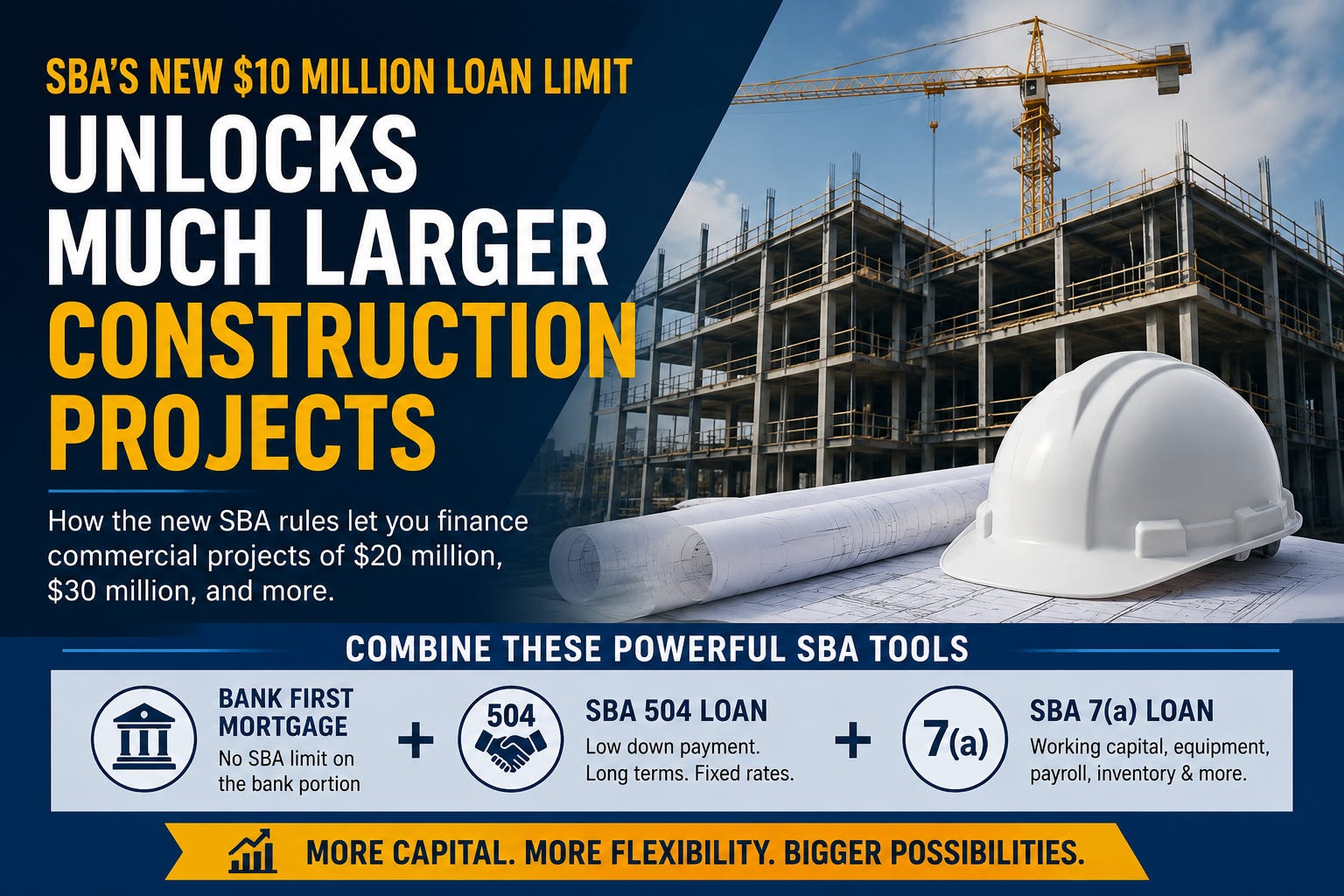
Beginning July 4, 2026, the U.S. Small Business Administration’s new lending rules allow eligible businesses to borrow up to $10 million in combined SBA financing by utilizing both the SBA 7(a) and SBA 504 loan programs. While many headlines focus on the new $10 million limit, the real opportunity is much bigger. Because an SBA 504 loan is paired with a bank’s first mortgage—which is not subject to SBA lending limits—qualified borrowers can now finance construction and commercial real estate projects well in excess of $20 million while also securing working capital through an SBA 7(a) loan.
For developers, contractors, manufacturers, hotel owners, RV park operators, and owner-occupied commercial real estate investors, this is one of the most significant SBA financing changes in decades.
What Changed with the SBA Loan Limits?
The SBA has separated the cumulative borrowing limits between its two flagship loan programs.
Eligible borrowers can now receive:
Up to $5 million through the SBA 7(a) Loan Program
Up to $5 million through the SBA 504 Loan Program
A combined total of $10 million in SBA-backed financing
Previously, borrowers were generally limited to a combined SBA exposure of $5 million, often forcing businesses to choose between financing their building or preserving working capital.
Now they can strategically use both programs together.
Why This Is Bigger Than a $10 Million Loan
The new cumulative limit is only part of the story.
The SBA 504 loan is structured differently than an SBA 7(a) loan.
Instead of financing 100% of the project, the 504 program typically consists of three components:
A bank first mortgage (typically 50% or more of the project cost)
An SBA/Certified Development Company (CDC) second mortgage (generally up to 40%)
A borrower equity injection (typically 10%–20%)
Here’s the key advantage:
The bank’s first mortgage is not limited by SBA loan limits.
That means banks can finance significantly larger first mortgages while the SBA provides a fixed-rate second mortgage and the borrower contributes the required equity.
The result is the ability to finance projects far larger than the SBA loan amount alone would suggest.
How You Can Finance Construction Projects Over $20 Million
Because the bank first mortgage has no SBA lending cap, businesses can structure substantially larger capital stacks.
Example: $20 Million Manufacturing Facility
Financing SourceAmountBank First Mortgage$10,000,000SBA 504 Second Mortgage$5,000,000Borrower Equity$5,000,000
Now add the new SBA 7(a) limit.
The borrower could obtain an additional $5 million SBA 7(a) loan for:
Working capital
Payroll
Inventory
Equipment
Furniture and fixtures
Operating expenses during construction
Business expansion costs
Total available capital:
Bank First Mortgage: $10 million
SBA 504: $5 million
SBA 7(a): $5 million
Total Financing Available: $20 Million
Even Larger Construction Projects Are Possible
Many commercial banks routinely originate first mortgages well above $10 million for qualified borrowers.
For example:
Financing SourceAmountBank First Mortgage$20,000,000SBA 504 Second Mortgage$5,000,000SBA 7(a) Working Capital$5,000,000Borrower Equity$5,000,000
Total Project Capital: $35 Million
The exact structure depends on lender credit policies, project economics, collateral, and borrower qualifications, but the important point remains:
The SBA loan limit is no longer the limiting factor for many owner-occupied construction projects.
Why Construction Companies Should Pay Attention
Construction companies often experience the greatest financing challenges because they need both long-term project financing and operating liquidity.
A growing contractor may need capital for:
Purchasing land
Ground-up construction
New headquarters
Equipment purchases
Fleet expansion
Payroll
Materials
Inventory
Hiring additional crews
Working capital while awaiting progress payments
The new SBA rules allow these financing needs to be separated into the most appropriate loan products instead of forcing one loan to accomplish everything.
How SBA 504 and SBA 7(a) Work Together
SBA 504 Loan
Best used for:
Land acquisition
Ground-up construction
Commercial buildings
Manufacturing facilities
Heavy equipment
Warehouse construction
Permanent financing
Benefits include:
Long repayment terms
Fixed interest rates
Lower monthly payments
Low down payment requirements
SBA 7(a) Loan
Best used for:
Working capital
Inventory
Payroll
Equipment
Furniture and fixtures
Business acquisitions
Operating expenses
Tenant improvements
Expansion costs
Together, the two programs create a financing solution that supports both the real estate investment and the day-to-day operational needs of the business.
Industries That Benefit Most
The expanded lending limits create significant opportunities for capital-intensive industries, including:
Commercial construction
General contractors
Manufacturing
Hotels
RV parks
Self-storage facilities
Distribution centers
Warehousing
Food processing
Industrial businesses
Medical office buildings
Logistics companies
These businesses often require large investments in real estate while simultaneously needing working capital to support growth.
Who Qualifies?
To qualify for SBA financing, businesses generally must:
Operate as a for-profit business in the United States
Meet SBA size standards
Demonstrate sufficient cash flow to repay the loan
Meet lender underwriting requirements
Provide the required borrower equity
Occupy the property being financed under SBA 504 occupancy rules
Each project is evaluated individually, and eligibility may vary depending on the lender and the financing structure.
Real-World Example
Imagine a regional contractor planning to build a new headquarters with office space, equipment storage, and a maintenance facility.
Project Costs:
Land: $2 million
Construction: $14 million
Equipment: $2 million
Furniture & Fixtures: $500,000
Working Capital: $3 million
Instead of relying solely on conventional financing, the business could structure the transaction using:
A bank first mortgage for the majority of the construction costs
An SBA 504 loan for long-term fixed-rate financing
An SBA 7(a) loan for working capital and business expansion
This approach preserves liquidity while giving the company the resources needed to grow during and after construction.
Why This Is One of the Biggest SBA Changes in Years
The new cumulative lending limits provide growing businesses with far greater flexibility than ever before.
Instead of viewing SBA financing as a solution only for smaller projects, business owners can now use SBA programs as part of sophisticated capital structures for much larger developments.
By combining:
A commercial bank first mortgage
SBA 504 fixed-rate financing
SBA 7(a) working capital
businesses can finance larger facilities, preserve cash, and position themselves for long-term growth.
For many owner-occupied construction projects, the total financing available can significantly exceed the SBA’s $10 million combined loan limit because the bank’s first mortgage is not subject to SBA maximums.
Frequently Asked Questions
Does the SBA now lend $10 million?
The SBA now allows eligible borrowers to receive up to $5 million through the SBA 7(a) program and up to $5 million through the SBA 504 program, for a combined total of $10 million in SBA-backed financing.
Can projects exceed $10 million?
Yes. Because the bank’s first mortgage in an SBA 504 transaction is not capped by SBA loan limits, many projects can exceed $20 million or more depending on the lender, borrower qualifications, and project economics.
Can I use both SBA programs together?
Yes. Many borrowers use the SBA 504 loan to finance real estate and construction while utilizing an SBA 7(a) loan for working capital, equipment, inventory, payroll, and other business expenses.
Is this good for construction companies?
Absolutely. Construction firms frequently need both permanent financing for facilities and flexible operating capital. The new rules make it easier to structure both.
Ready to Structure Your Next Construction Project?
The SBA’s expanded lending limits represent a major opportunity for businesses planning to build, expand, or invest in owner-occupied commercial real estate. While the headlines focus on a new $10 million SBA limit, experienced borrowers understand the real advantage lies in combining a commercial bank’s first mortgage with SBA 504 financing and an SBA 7(a) loan to create much larger capital stacks.
If you’re planning a construction project, manufacturing facility, hotel, RV park, warehouse, or commercial headquarters, our SBA lending specialists can help you structure financing that maximizes leverage, preserves working capital, and positions your business for long-term success.
Contact us today to discuss how the new SBA lending rules can help finance your next project.