


An SBA Rent Replacement Loan is not an official SBA loan program—it is a financing strategy that uses SBA 7(a) or SBA 504 loans to help business owners purchase the commercial property they occupy instead of continuing to lease it.
For qualified borrowers, some SBA lenders can structure 100% financing through an SBA 7(a) expansion loan, allowing business owners to replace their monthly rent payment with a mortgage payment while building equity.
If your business has a strong operating history and healthy cash flow, purchasing your building instead of leasing it may be one of the best long-term investments you can make.
What Is an SBA Rent Replacement Loan?
An SBA Rent Replacement Loan is a commercial real estate financing strategy designed for owner-occupied businesses.
Instead of paying rent to a landlord every month, the business purchases the building using SBA financing and begins making mortgage payments while building equity.
Common uses include:
Purchasing the building your business currently leases
Buying a larger building to support expansion
Refinancing an owner-occupied commercial property
Renovating or improving a recently purchased building
Purchasing land and constructing a new facility
The goal is simple: replace rent with ownership.
Why Business Owners Choose Rent Replacement Financing
Business owners often discover that their monthly rent payment is comparable to what a mortgage payment would be on a commercial property.
Benefits include:
Build equity instead of paying rent
Lock in long-term occupancy costs
Protect against annual rent increases
Gain complete control over your facility
Potential tax advantages (consult your CPA)
Own a valuable commercial asset that may appreciate over time
Rather than paying a landlord every month, your business begins investing in its own future.
How SBA Rent Replacement Financing Works
Most rent replacement transactions use one of two SBA loan programs.
SBA 7(a) Expansion Loan
The SBA 7(a) loan offers the greatest flexibility for purchasing owner-occupied commercial real estate.
It may be used for:
Buying commercial buildings
Business expansion
Renovations and tenant improvements
Equipment purchases
Working capital
Debt refinancing
Partner buyouts
Key Benefits
Loan amounts up to SBA program limits
Up to 25-year repayment for real estate
Fully amortizing loans
Competitive variable or fixed-rate options
Can finance multiple business needs within one loan
Can You Get 100% Financing?
Yes. In certain SBA 7(a) expansion loan transactions, 100% financing is possible.
For strong rent replacement opportunities, experienced SBA lenders may structure financing that allows qualified borrowers to purchase an owner-occupied commercial building with no borrower cash down.
These transactions generally require:
Strong historical business cash flow
Consistent profitability
Good personal and business credit
Owner-occupied commercial real estate
Debt service coverage that supports the new mortgage
A purchase price supported by the property’s appraised value
Instead of focusing solely on a down payment, lenders often evaluate whether the business has successfully demonstrated the ability to make monthly rent payments. When the projected mortgage payment is comparable and the business meets underwriting requirements, a 100% financing structure may be available.
Every transaction is different, and approval ultimately depends on lender underwriting and SBA eligibility requirements.
SBA 504 Loan
The SBA 504 Loan is designed specifically for purchasing fixed assets such as commercial real estate and heavy equipment.
It is often the preferred solution when purchasing:
Office buildings
Industrial properties
Manufacturing facilities
Medical buildings
Warehouses
Retail properties
Benefits include:
Long-term fixed-rate financing on a significant portion of the loan
Lower equity requirements than many conventional commercial loans
Up to 25-year repayment terms
Ideal for owner-occupied real estate purchases
Unlike the 7(a) program, SBA 504 loans are generally focused on fixed assets and do not include working capital.
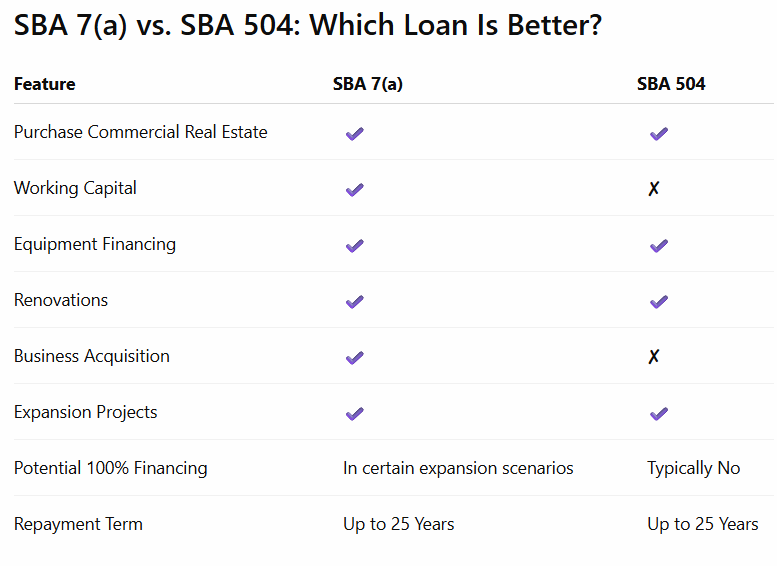
The best option depends on your business goals, cash flow, and financing needs.
Who Qualifies?
Most lenders look for businesses that demonstrate:
Owner occupancy of at least 51% of the building
At least two years in business (exceptions may apply)
Consistent profitability
Strong business and personal credit
Positive debt service coverage
Experienced management
Investment properties and passive rental real estate generally do not qualify for SBA financing.
How Lenders Evaluate Rent Replacement Loans
One of the most important underwriting considerations is whether the business can comfortably afford the new mortgage payment.
Lenders commonly review:
Historical rent payments
Business tax returns
Profit and loss statements
Balance sheets
Personal financial statements
Existing debt obligations
Debt Service Coverage Ratio (DSCR)
Many lenders target a DSCR of approximately 1.25x or greater, although requirements vary by lender and transaction.
Example Rent Replacement Scenario
A manufacturing company currently leases its building for $11,500 per month.
The building becomes available for purchase for $1.9 million.
Rather than signing another long-term lease, the company obtains an SBA 7(a) expansion loan to purchase the property. Because the business has strong historical cash flow and meets lender underwriting guidelines, the financing is structured with no borrower cash down.
Instead of continuing to pay rent to a landlord, the company now owns its facility, builds equity with each mortgage payment, and gains long-term control over its operating location.
Why Now Is a Good Time to Consider Purchasing Your Building
Owning your commercial property can create long-term stability and wealth for your business.
Advantages include:
Eliminate uncertainty from lease renewals
Hedge against rising rental rates
Increase business asset value
Improve long-term financial planning
Build equity instead of paying rent
Control future improvements and expansions
For businesses planning to remain in one location for years, ownership often becomes more attractive than leasing.
Frequently Asked Questions
Is an SBA Rent Replacement Loan an official SBA program?
No. It is a financing strategy that uses existing SBA 7(a) or SBA 504 loan programs to purchase owner-occupied commercial real estate.
Can I finance 100% of the purchase price?
Yes. Certain SBA 7(a) expansion loan transactions may qualify for 100% financing through participating lenders when the borrower and project meet underwriting guidelines.
Can investment properties qualify?
No. SBA commercial real estate loans require owner occupancy and are not intended for passive investment properties.
How much of the building must my business occupy?
For existing buildings, the business must generally occupy at least 51% of the property.
Can I include renovations in the loan?
Yes. SBA 7(a) loans can often finance renovations, improvements, equipment, and working capital as part of the overall project.
Final Thoughts
For business owners who are paying substantial monthly rent, purchasing their building with SBA financing can be a powerful long-term wealth-building strategy.
While an SBA Rent Replacement Loan is not a separate SBA program, SBA 7(a) and SBA 504 loans offer flexible financing solutions that allow qualified businesses to transition from leasing to ownership. In certain SBA 7(a) expansion transactions, experienced lenders can even structure 100% financing, enabling business owners to preserve working capital while investing in their future.
If your business has consistent cash flow, strong financials, and plans to remain in its current location for years to come, now may be the right time to explore replacing rent with ownership.
Ready to see if your business qualifies? Gather your current monthly rent, the estimated purchase price of the building, and your last three years of business financial statements. An experienced SBA lender can evaluate your eligibility and determine whether an SBA 7(a) expansion loan or SBA 504 loan is the best fit for your goals.