

SBA construction loans can be used to build owner-occupied industrial buildings for ecommerce and fulfillment businesses. Through SBA 7(a) and SBA 504 programs, qualified ecommerce operators can finance ground-up construction, expansions, or build-to-suit warehouses with as little as 10% down, long repayment terms, and competitive rates.
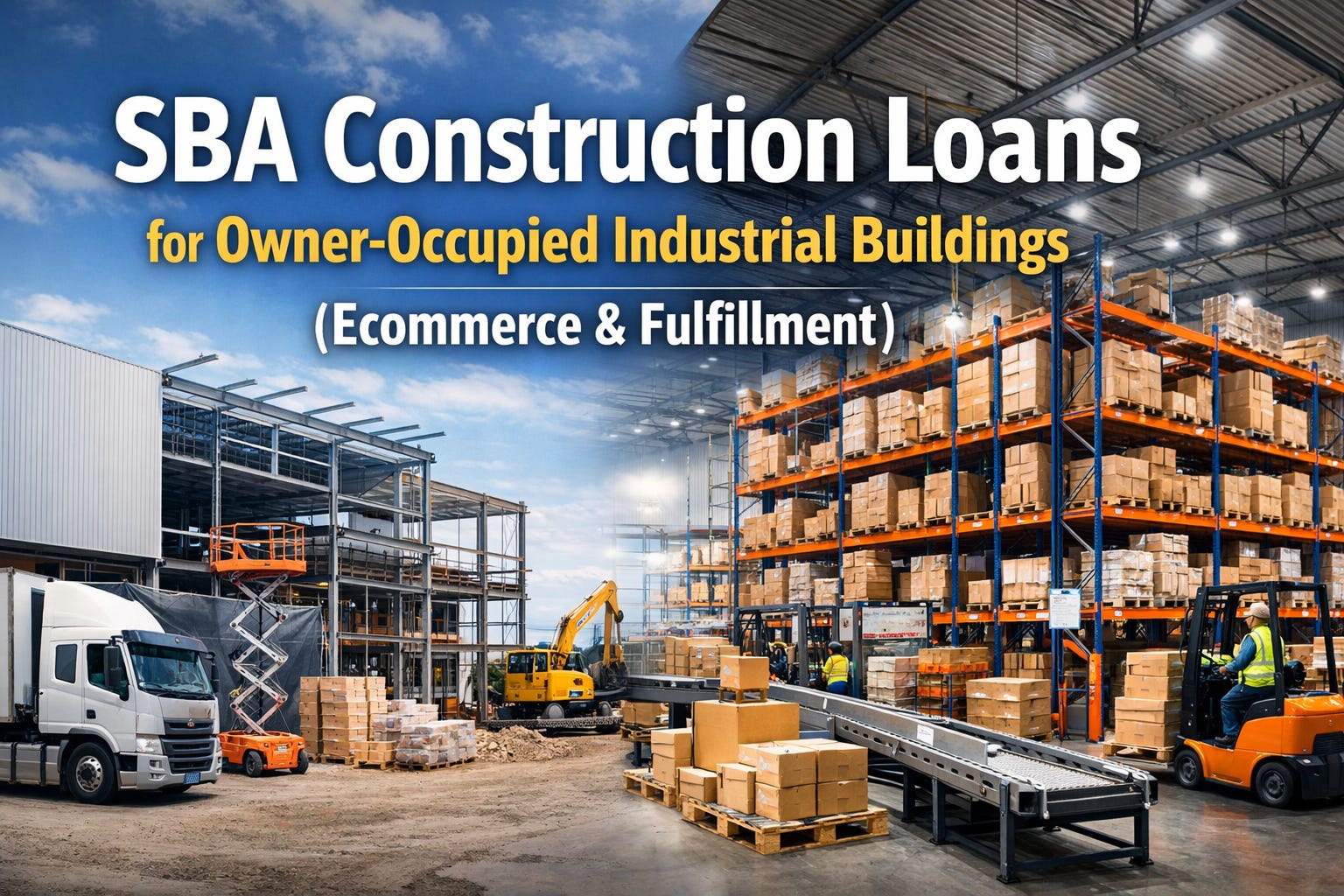
For ecommerce businesses that are outgrowing leased warehouse space, SBA construction financing is often the most cost-effective path to ownership.
Can You Use an SBA Construction Loan for an Owner-Occupied Industrial Building?
Yes, as long as the operating business occupies at least 51% of the property.
Key SBA requirements include:
The borrower must be an operating company, not a passive real estate investor
The business must occupy at least 51% of the building (60% for some new construction scenarios)
The project must directly support business operations
The borrower must meet Small Business Administration size and eligibility standards
Ecommerce businesses that store inventory, fulfill orders, process returns, or house operations in the building typically qualify without issue.
What Is SBA Construction Financing?
SBA construction financing allows small businesses to fund:
Ground-up industrial construction
Build-to-suit warehouses
Owner-occupied distribution centers
Expansion or renovation of existing facilities
Most SBA construction loans are structured with:
Interest-only payments during construction
Conversion to permanent financing upon completion
Fully amortizing terms of 20 to 25 years
Rather than lending directly, the Small Business Administration guarantees a portion of the loan issued by a bank or CDC lender, which allows for lower down payments and longer terms.
Why Owner-Occupied Industrial Buildings Are Attractive for Ecommerce Businesses
Many ecommerce operators are shifting from leasing to ownership as fulfillment demands grow.
Key advantages include:
Long-term cost control versus rising industrial rents
Custom layouts for fulfillment, automation, and logistics
Improved margins at scale
Equity creation instead of paying a landlord
Better operational efficiency and supply-chain control
For growing ecommerce brands, owning a warehouse can be a strategic growth lever rather than just a real estate decision.
SBA 7(a) vs SBA 504 for Ecommerce Warehouse Construction
SBA 7(a) Construction Loans
Best for flexibility and mixed-use financing.
Maximum loan size up to $5,000,000
Can include construction, land, equipment, and soft costs
Variable or fixed interest rates
One-loan structure with a single lender
SBA 7(a) loans work well for ecommerce businesses that want construction financing combined with working capital or equipment.
SBA 504 Construction Loans
Best for larger, real estate-heavy industrial projects.
Typical structure:
50% bank financing
40% SBA-backed CDC loan
10% borrower equity injection
Key benefits include:
Long-term fixed interest rates on the SBA portion
Lower effective borrowing costs
Terms of 20 to 25 years
SBA 504 loans are ideal for larger warehouses, automated fulfillment centers, and build-to-suit industrial facilities.
Owner-Occupancy Rules for Ecommerce and Fulfillment Buildings
To qualify as owner-occupied under SBA rules:
The ecommerce business must occupy at least 51% of total square footage
Operations such as inventory storage, fulfillment, returns, offices, and customer support count toward occupancy
Limited third-party leasing may be allowed if occupancy thresholds are met
Expansion projects may allow phased occupancy increases
This structure works particularly well for ecommerce companies with in-house fulfillment or hybrid 3PL models.
Common SBA Construction Use Cases in Ecommerce
SBA construction loans are commonly used for:
Ground-up fulfillment warehouse construction
Last-mile distribution centers
Combined warehouse and corporate headquarters
Replacing leased space with owned facilities
Expanding existing warehouse footprints
Adding automation, cold storage, or returns processing areas
Project sizes often range from $1.5 million to $15 million or more, depending on structure and location.
How Ecommerce Businesses Qualify for SBA Construction Loans
Most lenders evaluate:
Credit scores typically 680 or higher
Historical and projected cash flow
Ecommerce operating history
Post-closing liquidity
Detailed construction budgets with contingency
Experienced general contractors
Appraisals supporting stabilized value
Startup ecommerce businesses can qualify, but strong experience, conservative projections, and higher equity injections are often required.
Larger Ecommerce Projects Using SBA Pari Passu Structures
For projects exceeding SBA loan limits, some lenders use pari passu or companion loan structures:
An SBA loan funds part of the project
A bank participates alongside the SBA loan
Total financing can exceed standard SBA caps
SBA benefits still apply to the guaranteed portion
These structures are common for regional distribution hubs and large-scale fulfillment facilities.
Common Mistakes That Kill SBA Construction Deals
Avoid these issues:
Overly aggressive growth or volume assumptions
Underestimating soft costs and contingencies
Hiring an inexperienced general contractor
Unrealistic construction timelines
Failing to meet SBA occupancy requirements
Attempting to finance speculative excess space
SBA construction loans reward conservative planning and disciplined execution.
Final Thoughts: SBA Construction Loans for Ecommerce Growth
For ecommerce and fulfillment businesses, SBA construction loans provide a powerful way to own critical infrastructure, scale operations, and control long-term costs without excessive capital outlay.
If your business is outgrowing leased space or requires a custom-built industrial facility, SBA construction financing may be the most efficient path forward.