

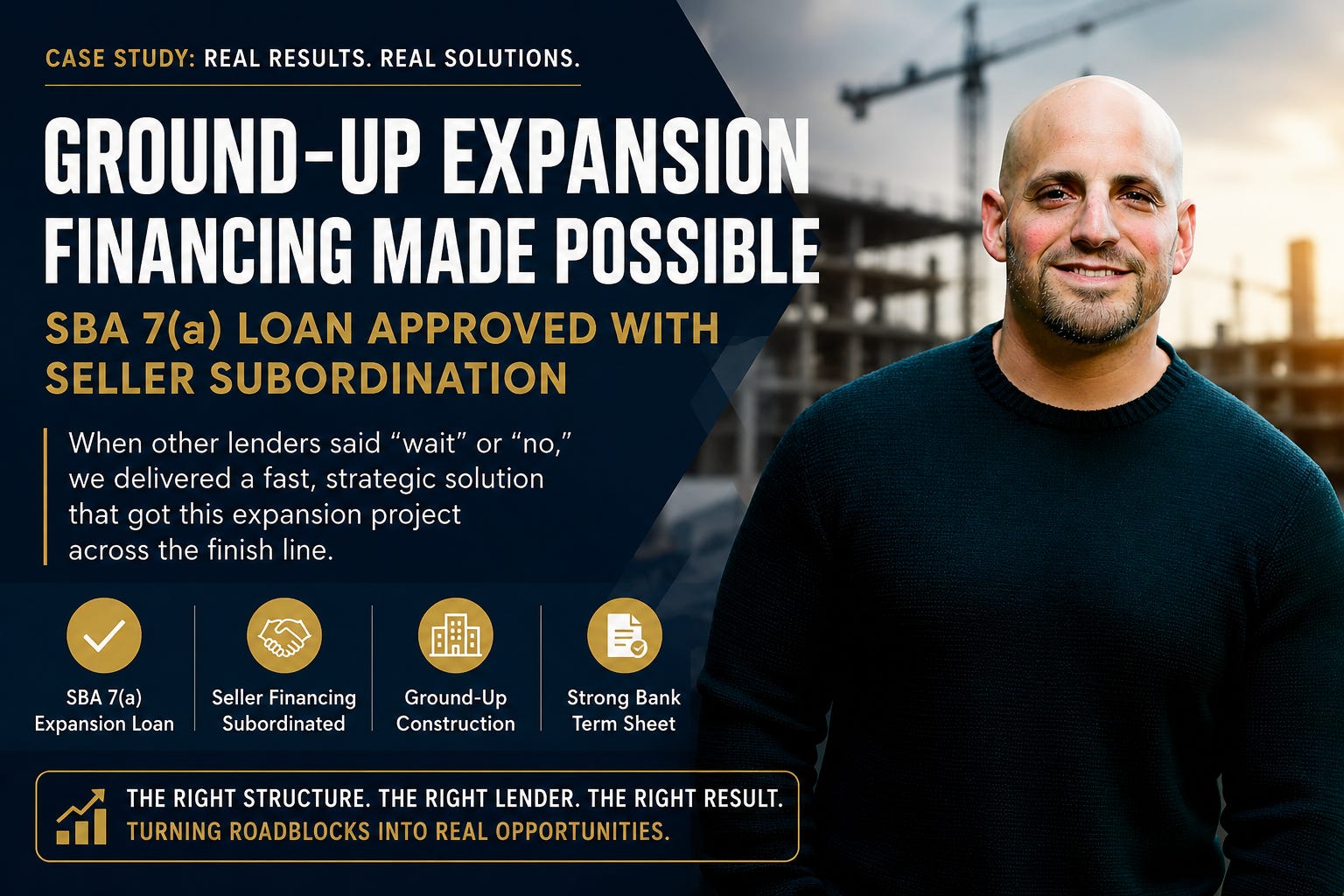
Getting approved for a ground-up expansion project isn’t always about having the perfect deal—it’s about finding the right lender and the right loan structure. In this case, we helped a business owner who had spent months talking with lenders without receiving meaningful progress. Within a short period, we structured an SBA 7(a) financing solution that included seller subordination, resulting in a strong bank term sheet for a multi-million-dollar expansion project.
Ground-Up Business Expansion Financing with an SBA 7(a)
Many entrepreneurs assume that new construction projects require large down payments or conventional construction financing. While that’s true in some cases, an SBA 7(a) loan can often provide a much more flexible solution—especially when the project qualifies as a business expansion rather than a startup.
For this borrower, the objective was to build a new owner-operated facility that expanded an already successful operating business. The challenge wasn’t the experience, financial strength, or business plan.
The challenge was finding a lender willing to understand the structure.
The Problem: Plenty of Conversations, No Progress
Before reaching out to us, the borrower had already spent months speaking with multiple lenders.
Despite having:
Industry experience
Existing successful operations
A detailed business plan
Financial projections
Construction budgets
Sources and uses prepared
A qualified expansion project
...the borrower wasn’t receiving real term sheets.
Instead, the feedback was inconsistent.
One lender suggested a 504 loan.
Another preferred conventional financing.
Others wanted permits completed before engaging.
Some simply wouldn’t issue a proposal.
As we discussed during our initial strategy call, the borrower expressed frustration that every lender had a different interpretation of SBA eligibility and structure, leaving the project stalled despite being well prepared.
Understanding the Real Obstacle
After reviewing the project, it became clear the biggest issue wasn’t credit.
It was capital structure.
The land seller preferred to keep part of the purchase price financed rather than receiving all cash at closing.
Many borrowers immediately assume this creates an SBA problem.
In reality, seller financing can work extremely well when it is structured correctly.
The key is subordination.
The SBA 7(a) Structure That Solved the Deal
Instead of forcing a structure that didn’t fit, we worked through an SBA 7(a) expansion strategy.
The structure included:
Ground-up construction financing
Business expansion qualification
Seller-financed land component
Seller agreeing to subordinate their note behind the SBA lender
Construction financing rolled into one SBA loan
Interest-only period during construction
Long-term fully amortizing financing after completion
This approach solved multiple problems simultaneously.
Rather than requiring the seller to be paid in full immediately, the seller retained a subordinated position while the bank maintained the first-priority lien required for SBA financing.
That flexibility helped move the transaction forward.
Why Seller Subordination Can Be a Powerful Tool
Seller financing is often viewed only as a way to reduce a buyer’s cash requirement.
In larger SBA expansion projects, it can also become a strategic tool.
Benefits include:
Helps bridge capital gaps
Keeps sellers invested in project success
Preserves borrower liquidity
Creates additional flexibility during negotiations
Allows SBA lenders to maintain required collateral position
When properly documented and approved by the lender, subordinated seller financing can make otherwise difficult transactions financeable.
A Strong Bank Term Sheet Arrived Quickly
Once the project was packaged correctly and presented to the right SBA lender, momentum changed quickly.
Rather than endless conversations, the borrower received a formal proposal outlining financing for approximately $4.7 million using an SBA 7(a) structure for ground-up construction and startup costs. The proposal included construction funding, working capital, interest reserves, a 12-month interest-only construction period, and a 25-year amortization following construction, subject to final underwriting and SBA approval.
This is exactly why lender selection matters.
Every bank has different credit preferences.
Every SBA department interprets guidelines slightly differently.
Knowing which lenders actively finance ground-up construction can dramatically reduce wasted time.
Why SBA 7(a) Worked Better Than SBA 504
Many borrowers automatically assume the SBA 504 program is the best option for construction.
Sometimes it is.
In this case, however, the SBA 7(a) offered several advantages discussed during the planning process:
Simpler single-loan structure
Greater flexibility during construction
Expansion eligibility
Ability to incorporate working capital
Easier path around certain equity challenges
Potential refinance into lower-cost financing after stabilization
During the initial strategy discussions, we reviewed both SBA 504 and SBA 7(a) options before determining that the 7(a) structure was likely the better fit for this specific expansion.
What This Case Study Demonstrates
This transaction wasn’t unusual because it involved new construction.
It was unusual because the financing required someone willing to structure the deal instead of simply saying “no.”
Too often borrowers hear:
“Come back later.”
“We don’t finance that.”
“The seller financing won’t work.”
“Wait until permits are finished.”
Sometimes those concerns are valid.
Other times, they’re simply lender preferences—not SBA rules.
Finding the right lender often matters just as much as having the right borrower.
Ground-Up SBA Financing Requires More Than an Application
Large expansion projects require careful coordination between:
Construction budgets
Equity injection
Sources and uses
Builder qualifications
Business projections
Collateral analysis
Seller financing documents
SBA eligibility
Bank credit policy
When these pieces align, projects that seemed impossible often become financeable.
Final Thoughts
Ground-up expansion financing isn’t about checking boxes.
It’s about designing the right capital stack.
In this case, a borrower who had spent months spinning their wheels with multiple lenders finally received a strong SBA 7(a) term sheet after the project was properly structured and matched with a lender experienced in complex expansion financing.
If you’re planning a ground-up business expansion, purchasing land with seller financing, or trying to determine whether your project qualifies under SBA guidelines, don’t assume the first answer you receive is the only answer. The right financing structure—and the right lender—can make all the difference.