

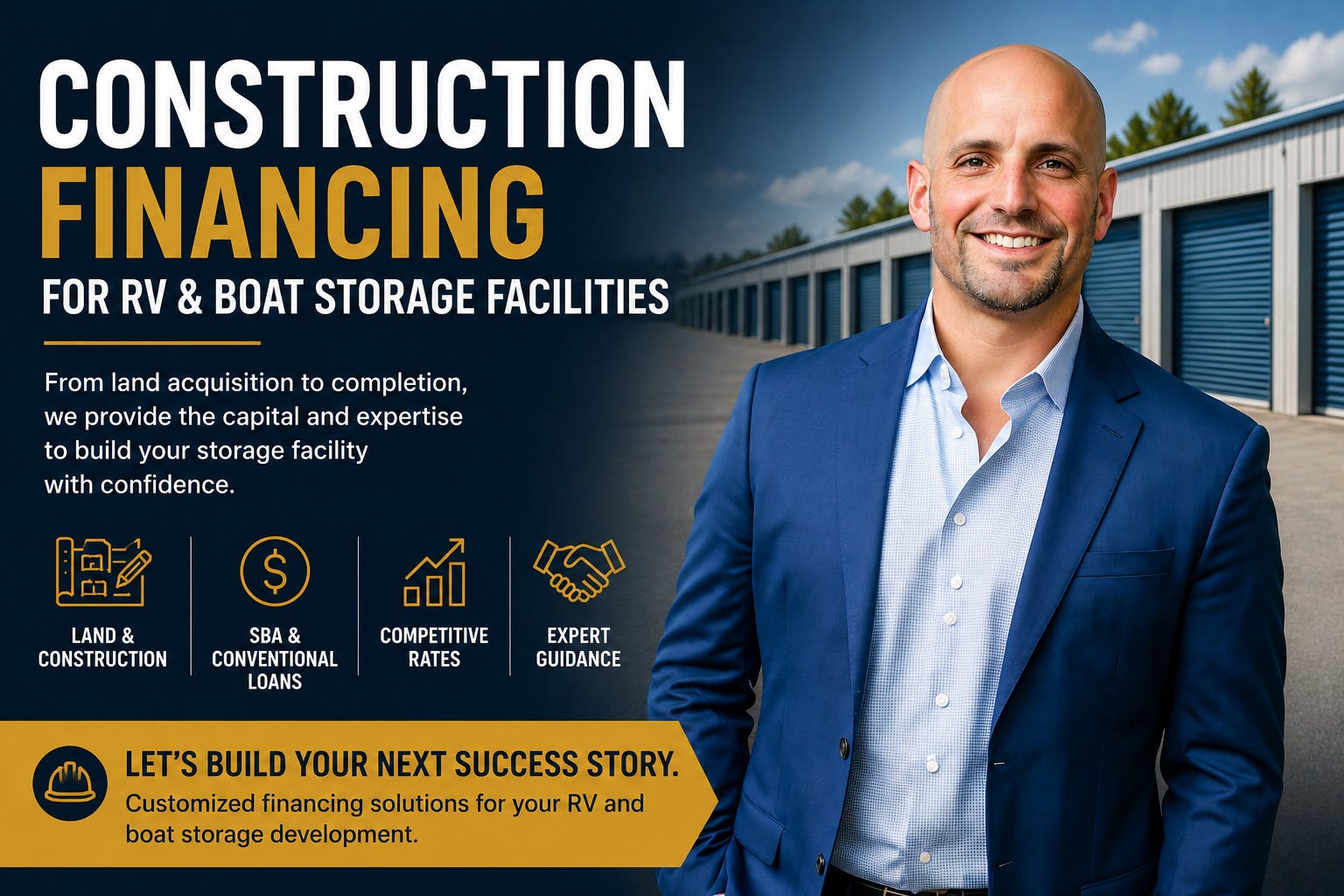
Construction financing for an RV and boat storage facility provides the capital needed to purchase land, develop infrastructure, and construct storage buildings before the property begins generating revenue. Many developers ultimately convert construction financing into long-term commercial or SBA financing once the project is complete and stabilized.
With demand for secure RV and boat storage continuing to grow across the United States, these facilities have become one of the most attractive commercial real estate investments due to relatively low operating costs, recurring rental income, and expanding outdoor recreation markets.
Construction Financing for Building an RV and Boat Storage
If you’re planning to develop an RV and boat storage facility, construction financing can cover nearly every phase of development.
Typical construction financing may include:
Land acquisition
Site development and grading
Utilities and drainage
Concrete paving
Security fencing and gated access
Covered canopy storage
Fully enclosed storage buildings
Office and leasing space
Security cameras and lighting
Landscaping
Engineering, architectural, and permit costs
Construction interest reserve
Soft costs and contingency
Most lenders fund construction in stages through draw requests as work is completed.
Why RV and Boat Storage Is an Attractive Investment
RV and boat ownership has increased significantly over the past decade, while many homeowners’ associations prohibit storing large recreational vehicles at home.
This creates strong demand for professionally managed storage facilities offering convenience, security, and flexible rental options.
Benefits include:
Recurring monthly rental income
Lower operating expenses than many commercial properties
Minimal staffing requirements
High tenant retention
Multiple revenue streams
Strong appreciation potential
Growing outdoor recreation industry
Many facilities also generate additional income through:
Covered premium storage
Fully enclosed climate-controlled units
Wash stations
Dump stations
Air compressor stations
Battery charging
Retail supplies
Insurance commissions
Online reservations and autopay
Well-designed facilities often achieve attractive operating margins because maintenance requirements are relatively low compared to apartments, hotels, or retail centers.
What Lenders Look for When Financing an RV and Boat Storage Development
Construction lenders evaluate both the borrower and the project.
Key underwriting factors include:
Experience with commercial real estate development
Credit history
Liquidity
Net worth
Detailed construction budget
Builder qualifications
Market feasibility study
Projected occupancy
Business plan
Appraisal
Environmental reports
Civil engineering plans
Exit strategy
Many lenders also require a meaningful borrower equity contribution before funding construction.
Construction Loan Options
Several financing structures are available depending on the size and complexity of the project.
Conventional Construction Loans
Traditional banks frequently finance RV and boat storage developments.
Advantages include:
Competitive interest rates
Large loan amounts
Flexible project sizes
Permanent financing options after completion
These loans generally require:
20%–35% equity
Strong borrower financials
Proven development experience
SBA 7(a) Loans
An SBA 7(a) loan may finance smaller owner-occupied RV and boat storage facilities when the operating business occupies the required percentage of the property.
The SBA 7(a) program can finance:
Land acquisition
Construction
Building improvements
Equipment
Working capital
Business acquisition
Benefits include:
Lower down payments than many conventional loans
Longer repayment terms
Flexible use of proceeds
SBA 504 Loans
The SBA 504 loan program is often an excellent solution for owner-occupied commercial real estate developments.
Typical benefits include:
Long-term fixed interest rates on the SBA portion
Lower equity requirements for qualified borrowers
Financing for land and construction
Predictable monthly payments
The property generally must meet SBA owner-occupancy requirements.
SBA Loan Comparison
Loan ProgramBest ForTypical UseSBA 7(a)Smaller owner-operated facilitiesConstruction, land, working capitalSBA 504Owner-occupied real estateLong-term fixed-rate construction financingConventional ConstructionInvestment developmentsLarger commercial projectsBridge FinancingTime-sensitive acquisitionsShort-term construction or refinancing
Larger RV and Boat Storage Projects Using SBA Pari Passu Financing
For larger owner-occupied developments that exceed standard SBA financing limitations, some lenders utilize SBA pari passu financing.
Under this structure:
The SBA-guaranteed loan is paired with a companion conventional loan.
Both loans share the same collateral position.
Borrowers can finance larger projects while maintaining many SBA advantages.
The structure may increase total available financing for qualifying businesses.
Pari passu financing can be especially valuable for developers constructing premium RV and boat storage facilities with covered parking, enclosed buildings, office space, and extensive site improvements.
Example Financing Scenario
A developer identifies a 12-acre parcel near a rapidly growing lake community with strong boating activity.
The project includes:
450 storage spaces
Covered RV storage
Enclosed premium units
Gated electronic access
Security cameras
On-site manager office
Wash station
Dump station
The construction lender funds the project through scheduled draws during development. Once construction is complete and occupancy reaches stabilization, the borrower refinances into long-term permanent financing with lower monthly payments.
How to Qualify for Construction Financing
To improve financing approval odds, borrowers should prepare:
Personal financial statement
Business financial statements
Tax returns
Construction budget
Contractor bids
Architectural plans
Civil engineering reports
Project timeline
Market analysis
Pro forma financial projections
Sources and uses of funds
Equity verification
Working with an experienced commercial mortgage advisor early in the planning process can help identify the financing structure best suited for the project.
Frequently Asked Questions
Can construction financing include land purchases?
Yes. Many lenders finance both land acquisition and vertical construction as part of one loan.
How much equity is typically required?
Many commercial construction lenders require approximately 20%–35% borrower equity, although requirements vary based on project risk and borrower experience.
Can SBA financing be used for construction?
Yes. SBA 7(a) and SBA 504 loans can finance eligible owner-occupied construction projects that meet SBA program requirements.
How long does construction financing last?
Most construction loans have terms ranging from 12 to 36 months before converting to or refinancing into permanent financing.
Are RV and boat storage facilities considered good investments?
Many investors view RV and boat storage as attractive because of recurring rental income, relatively low operating costs, limited staffing needs, and growing demand driven by increasing recreational vehicle and boat ownership.
Conclusion
Construction financing is the foundation of a successful RV and boat storage development. Whether you’re building an uncovered storage yard, premium covered parking, or a fully enclosed storage complex, selecting the right financing structure can significantly impact your project’s profitability.
Conventional construction loans remain the primary choice for investment developments, while SBA 7(a) and SBA 504 loans can provide outstanding solutions for owner-occupied facilities. Larger projects may also benefit from SBA pari passu financing when additional capital is required.
Planning early, assembling an experienced development team, and working with lenders familiar with self-storage and RV storage projects can help streamline the approval process and position your investment for long-term success.
Ready to finance your RV and boat storage project? Speak with an experienced commercial and SBA lending specialist to evaluate construction financing options, compare loan structures, and secure the capital needed to bring your development from concept to completion.